
Who Makes the Best Oxygen Concentrator?
Distributors entering the oxygen concentrator market face a deceptively simple question: who makes the best one? The problem is that "best" obscures the real sourcing decision. Ask the wrong question, and you risk locking into a supplier that looks strong on paper but fails you in the market that actually matters — yours.
There is no single best oxygen concentrator manufacturer. The right question is: which manufacturer is best-matched to your target market, compliance requirements, and supply chain risk tolerance? A manufacturer with proven vertical integration, the regulatory clearances your market requires, and genuine OEM/ODM support will consistently outperform a brand-heavy supplier with limited factory control — regardless of how the latter ranks in a general comparison.
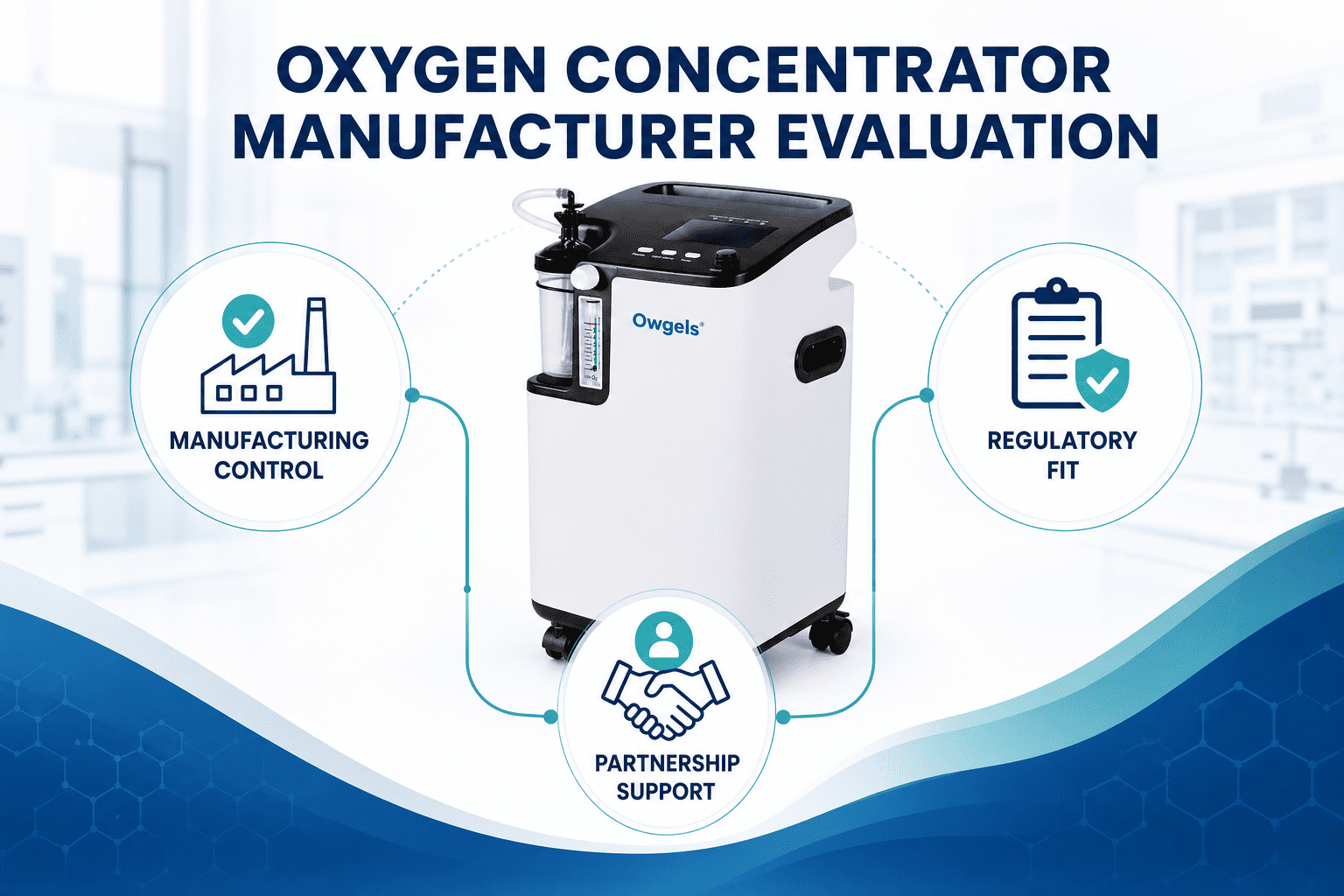
That reframe changes everything about how you evaluate suppliers. The sections below break down the three dimensions that actually determine which oxygen concentrator manufacturer is right for your business — and why the loudest brand name is often the last place to start.
Is Brand Recognition a Reliable Signal of Manufacturing Quality?
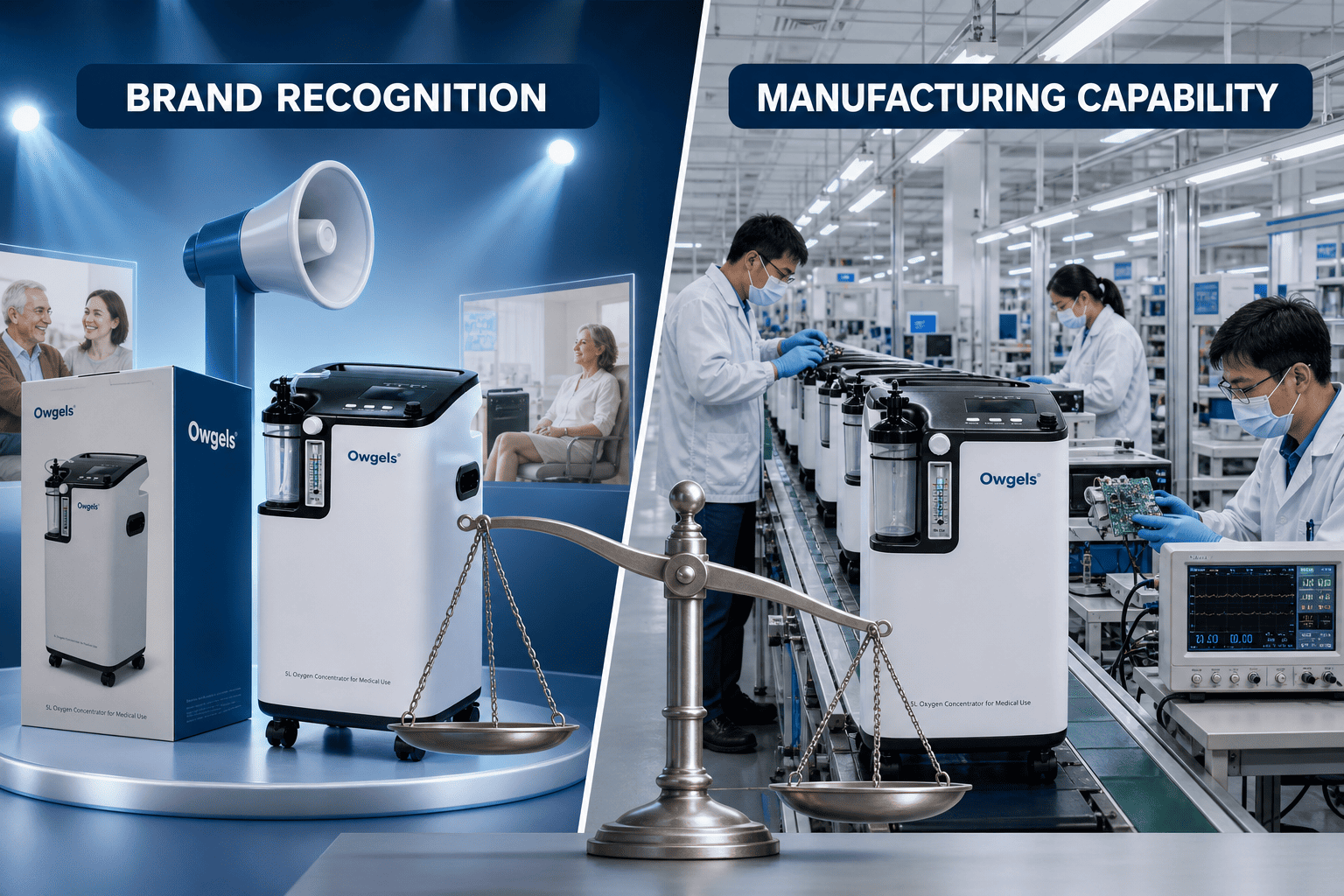
Many distributors begin their supplier search by Googling the most recognized names. That feels like due diligence. But in the oxygen concentrator industry, brand recognition and manufacturing capability are not the same thing1 — and confusing them is an expensive mistake.
Brand recognition reflects marketing investment. Manufacturing capability reflects what happens inside a factory. A distributor staking a market entry on the wrong assumption between these two will eventually feel the gap — usually when lead times slip or a quality issue surfaces with no clear owner.
Many Recognized Brands Are Not Manufacturers
In conversations with distributors across Europe, Southeast Asia, and Latin America, one pattern comes up consistently: buyers are surprised to learn that the brand on the box and the factory making the product are often different companies. This is common across medical devices, not unique to oxygen concentrators.2
A brand entity handles marketing, distribution, and customer-facing support. The actual product engineering, production, assembly, and quality control happen at a contract manufacturer — sometimes with limited oversight from the brand itself.
This structure creates real risk for distributors:
- Slower iteration cycles. When you need a label change, voltage adaptation, or packaging modification for your local market, you are waiting on a brand entity to coordinate with a factory it may not fully control.
- Diffuse accountability. If a quality issue arises, the brand points to the factory. The factory points to the specification. You are caught between.
- Limited flexibility. OEM and ODM customization — private labeling, modified feature sets, local-language interfaces — is harder to negotiate when the brand is not the manufacturer.
What to Ask Instead of "Is This Brand Reputable?"
The more productive question is: who actually manufactures this product, and what control do they have over the production chain?
Specifically, ask any prospective supplier:
- Do you own the manufacturing facilities producing this product?
- Is R&D conducted internally, or is product development outsourced?
- What does your quality control process look like from incoming materials to final inspection?
- Can you support OEM or ODM modifications, and at what stage of production?
A manufacturer that controls R&D, production, assembly, testing, and QC under one roof can answer all four questions directly. One that cannot should raise flags — not necessarily disqualifying flags, but ones worth probing before you commit.
In our experience, the distributors who ask these questions early avoid the most common sourcing regret in this category: choosing a supplier they can't grow with.
Does Regulatory Certification Tell You Which Manufacturer Is Best?
Regulatory clearance is often treated as a quality signal. Buyers see "FDA-cleared" or "CE-marked" and assume this means the product has been independently validated as high-performing. That interpretation overstates what certification actually does.
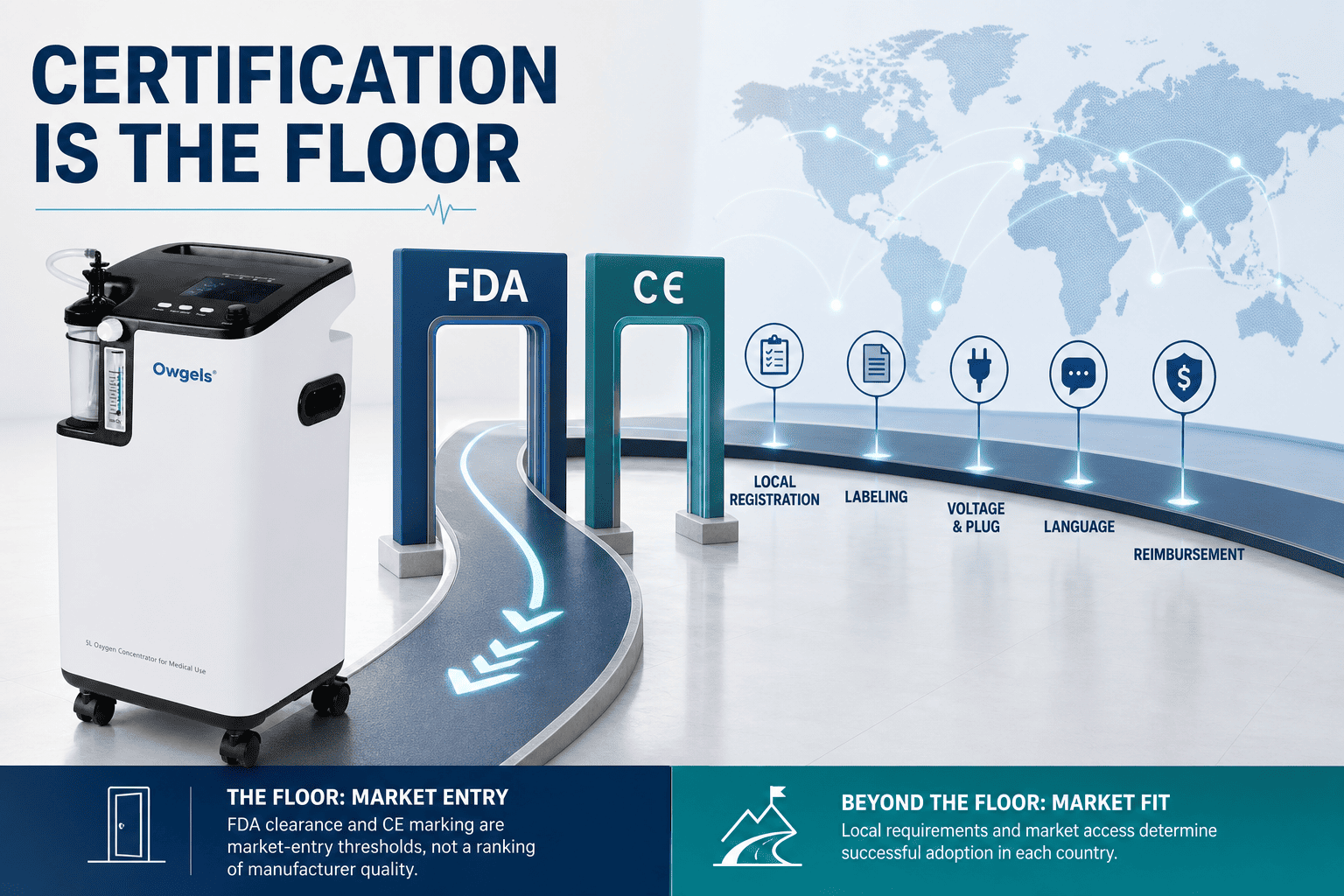
Regulatory certification is a market entry threshold.3 It confirms that a product meets defined safety and performance requirements for a specific market. It does not rank manufacturers, compare product quality across brands, or guarantee that the product fits your market's specific distribution, reimbursement, or labeling requirements.4
Certification Is the Floor, Not the Ceiling
Think of FDA clearance and CE marking as the minimum standard for playing in a given market — not the differentiator that determines which manufacturer wins in that market.
This distinction matters practically. Consider what certification does and does not cover:
| Factor | Covered by FDA/CE? | What It Actually Requires |
|---|---|---|
| Safety performance thresholds | Yes | Manufacturer to document and demonstrate |
| Oxygen purity output5 | Partially | Meets defined minimums; does not rank devices |
| Country-specific labeling6 | No | Separate local requirement |
| Reimbursement eligibility7 | No | Determined by national payer systems |
| Voltage and plug standards8 | No | Separate adaptation required |
| Language requirements | No | Market-specific compliance |
Regulatory Fit Means More Than Having a Certificate
A manufacturer that holds FDA clearance and CE marking has cleared the legal threshold for those markets. But a distributor entering, say, a specific Latin American country with a national health insurance reimbursement scheme will need more than a CE certificate. They will need a supplier who understands local registration requirements, can support documentation packages, and has delivered into comparable regulatory environments before.
What we typically see in pre-sales conversations is that distributors who focus only on whether a certificate exists often miss whether the manufacturer can support the full compliance journey in their specific country. That support — documentation, technical files, post-market requirements — is part of what you are buying when you choose a manufacturing partner.
The right question is not "does this manufacturer have FDA or CE?" It is: does this manufacturer's regulatory portfolio match the markets I am entering, and can they support my compliance process in those markets?
Why Does Vertical Integration Matter for Long-Term Supply?
Vertical integration is a phrase that gets used a lot in manufacturing marketing. It sounds impressive without always being explained. For distributors evaluating oxygen concentrator suppliers, it has specific, practical implications for supply reliability, quality traceability, and the ability to customize products for local markets.
A vertically integrated manufacturer controls the full production chain9 — from component sourcing and product engineering through assembly, testing, and quality inspection — within its own facilities. A non-integrated supplier sources from multiple external vendors and assembles or coordinates production across parties it does not fully control.
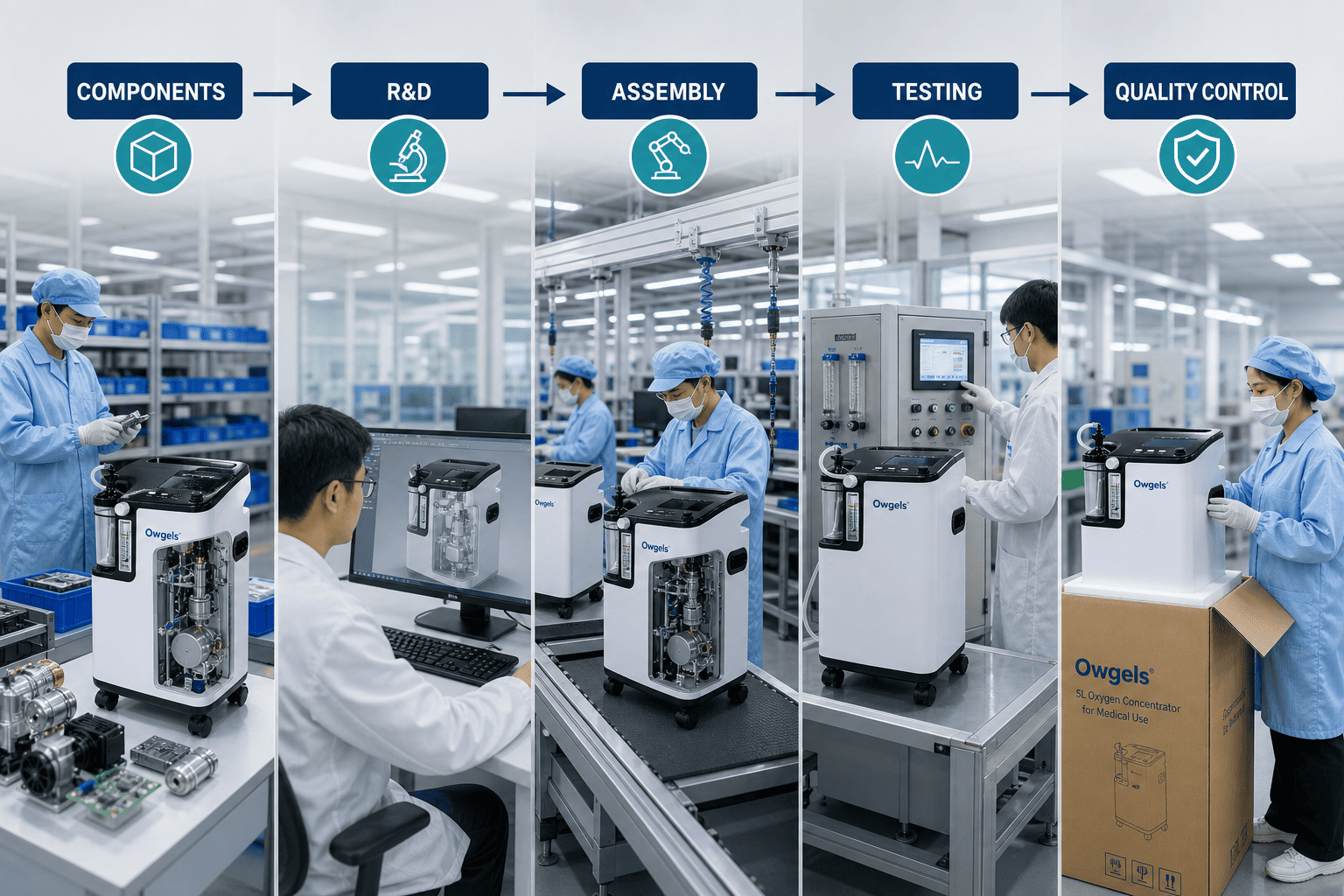
What Vertical Integration Changes for Distributors
The practical difference shows up in three areas:
When a manufacturer controls its own production, it has more levers to pull when supply conditions change. Component shortages, shipping disruptions, and demand surges are all easier to manage when the manufacturer is not waiting on a third-party factory to reprioritize its production schedule.
A common scenario we see: a distributor places a large reorder expecting eight-week lead times based on prior experience. An external supply disruption affects the contract factory their brand-supplier uses. The brand has limited visibility and less leverage to accelerate production. Lead times stretch. The distributor faces stock gaps.
A vertically integrated manufacturer in the same scenario has internal visibility into where the bottleneck is and more direct options for resolving it.
2. Quality traceability
When quality issues arise — and in any manufacturing operation, they do arise — the critical factor is how quickly the root cause can be identified and corrected11. In a vertically integrated operation, quality data from incoming materials, in-process checks, and final inspection all live within one system. Investigations are faster. Corrective actions are implemented without waiting for an external factory to cooperate.
For distributors, this means a faster, more transparent response when you raise a concern — and more confidence that systemic issues are being addressed, not passed between parties.
3. OEM and ODM capability
Private labeling, custom packaging, localized user interfaces, modified feature sets for specific clinical environments — all of these require a manufacturer that controls the design and production of the product it is modifying. A brand entity sitting on top of a third-party factory has limited ability to offer this without adding significant time and cost.
What to Look for When Evaluating Integration Claims
Not every supplier that claims vertical integration actually has it. During supplier evaluation, ask for:
- A facility overview showing where each stage of production occurs
- Clarity on which components are manufactured internally versus sourced externally
- Evidence of an internal quality management system with documented control points
- Technical team availability for OEM/ODM discussions — if engineering is external, the claim is hollow
Owgels operates manufacturing facilities in Guangzhou and Changsha with integrated production, assembly, testing, and quality control under one roof. In our pre-sales conversations, we walk distributors through exactly this structure — not as a marketing claim, but because understanding it is essential for a distributor to assess their supply chain risk accurately.
What Framework Should Distributors Use to Evaluate Any Manufacturer?
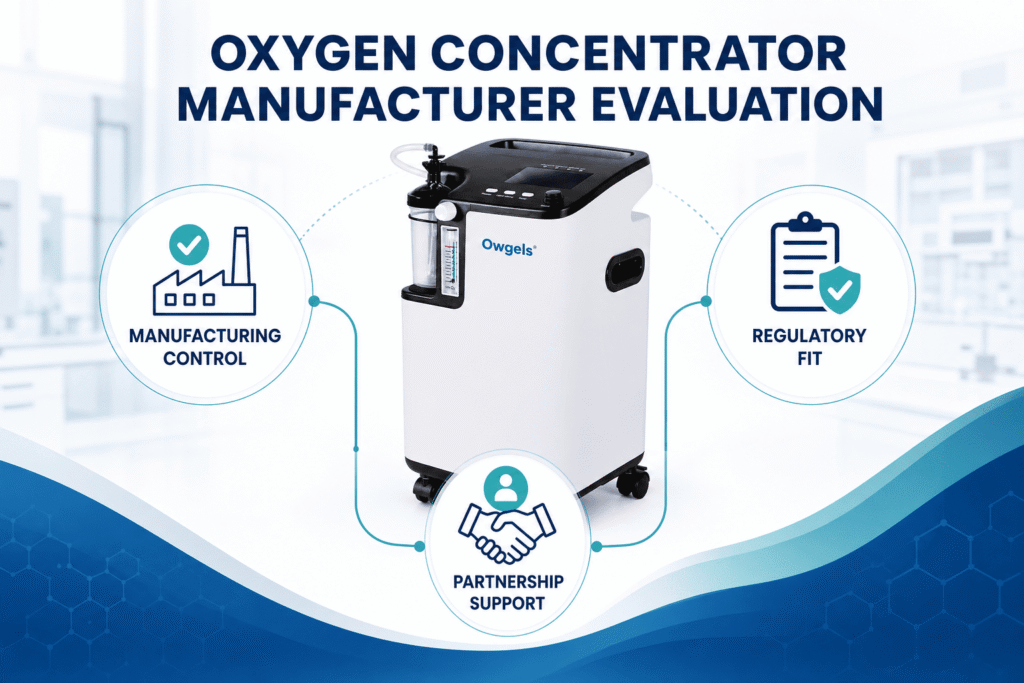
Pulling the previous sections together, the evaluation question for distributors is not "who makes the best oxygen concentrator?" It is: which manufacturer scores well across manufacturing control, regulatory fit, and long-term partnership support — in that order?
These three dimensions form a practical evaluation framework that applies to any supplier, not just Owgels.
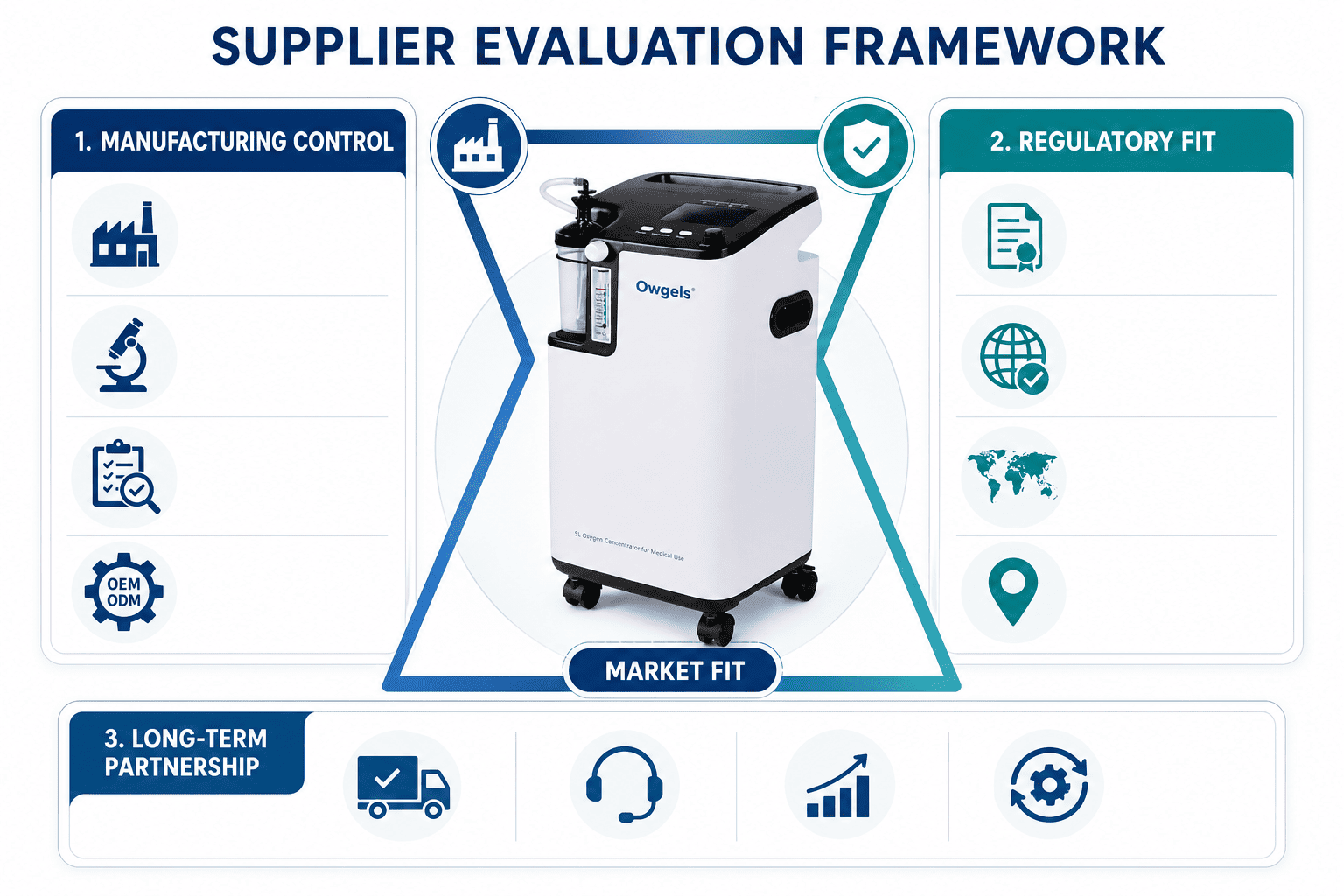
The Three-Dimension Evaluation Framework
Dimension 1: Manufacturing Control
- Does the manufacturer own its production facilities?
- Is R&D conducted internally?
- Are quality control processes documented and traceable end-to-end?
- Can the manufacturer support OEM/ODM requirements without external dependencies?
Dimension 2: Regulatory Fit
- Does the manufacturer hold the certifications required for your target market?
- Can they support local registration processes, not just hand you a certificate?
- Do they have experience supplying into comparable regulatory environments?
- Are voltage, labeling, and language adaptations within their capability?
Dimension 3: Long-Term Partnership Support
- What is the manufacturer's track record for delivery consistency over multiple years?
- Do they have a dedicated technical and pre-sales team to support your market entry?
- Can they scale with your volume as your market grows?
- How do they handle quality issues — response time, root cause process, corrective action?
Scoring This Framework in Practice
No supplier will score perfectly across all three dimensions for all markets. The goal is not perfection. It is clarity about where the gaps are and whether those gaps are dealbreakers for your specific situation.
A manufacturer with strong vertical integration but limited regulatory experience in your target country may still be the right partner if they are willing to support the registration process with documentation and technical resources. A manufacturer with broad certifications but limited OEM capability may work for a distributor who does not need private labeling — but will frustrate one who does.
Use this framework to have structured conversations with prospective suppliers. Their answers — and the speed and depth with which they answer — will tell you as much as the answers themselves.
Frequently Asked Questions
How do I verify whether a manufacturer actually owns its factory?
Ask for a facility tour — virtual or in-person — and request documentation showing the manufacturer's registered address and production locations. Legitimate vertically integrated manufacturers will readily provide this. Evasive responses or redirects to "our production partners" are a signal worth probing further.
Is a higher oxygen purity output always better for my market?
Not necessarily. Clinical use cases, physician prescription norms, and altitude conditions12 in your target market all affect what output specifications are appropriate. Buyers we work with often ask about purity first — but the more important question is whether the product's full specification profile matches your end-user environment and local regulatory requirements.
What does OEM/ODM support actually include in practice?
This varies significantly by manufacturer. At minimum, OEM support should include private labeling and packaging customization. Full ODM capability extends to modified product features, localized user interfaces, and custom engineering to specification. When evaluating suppliers, ask for specific examples of prior OEM/ODM projects and confirm that engineering is handled internally.
How important is it that a manufacturer has 15+ years of experience?
Tenure matters when it reflects continuous delivery, not just years in business. A manufacturer with 15+ years of consistent supply to international markets has navigated regulatory changes, supply disruptions, and market evolution in ways a newer entrant has not. Ask for evidence of that delivery record — not just a founding date.
Should I prioritize FDA clearance, CE marking, or both?
That depends entirely on your target markets. FDA clearance is required for the United States. CE marking covers European and many internationally aligned markets. If you are building a multi-market distribution business, you will want a manufacturer that holds both and can support the compliance requirements of each. Certification in only one jurisdiction limits your flexibility as your business grows.
Conclusion
The question of who makes the best oxygen concentrator has no universal answer — and any supplier who claims otherwise is selling, not advising. What matters for distributors and medical-device businesses is a more precise question: which oxygen concentrator manufacturer offers the right combination of manufacturing control, regulatory fit, and long-term partnership support for your specific markets and business goals?
Manufacturers with genuine vertical integration, traceable quality systems, and demonstrated OEM/ODM capability give distributors the supply chain resilience and flexibility that brand-heavy, factory-light suppliers cannot match. Owgels has built its business on exactly this model — 15+ years of continuous international delivery, dual FDA and CE certification, and integrated manufacturing facilities designed to support partners from first order to full market development.
If you are evaluating oxygen concentrator suppliers for long-term partnership, we welcome a direct conversation. Start with the framework. Bring your hardest questions. That is where the real evaluation begins.
"Who Must Register, List and Pay the Fee", https://www.fda.gov/medical-devices/device-registration-and-listing/who-must-register-list-and-pay-fee. Regulatory guidance distinguishing specification developers, manufacturers, and contract manufacturers supports the point that the company marketing a medical device may not be the same entity that physically manufactures it. Evidence role: general_support; source type: government. Supports: Medical-device regulatory systems recognize multiple responsible parties, including specification developers and contract manufacturers, which supports the distinction between a brand owner and the actual manufacturing entity.. Scope note: Such guidance supports the structural distinction but does not quantify how often this occurs specifically in oxygen concentrators. ↩
"Medical Device Supply Chain and Shortages", https://www.fda.gov/medical-devices/medical-device-safety/medical-device-supply-chain-and-shortages. Research on medical-device outsourcing documents the established use of contract manufacturers for design, production, and related services, providing contextual support for the claim that brand ownership and manufacturing are often separated. Evidence role: general_support; source type: research. Supports: The source should document that contract manufacturing and outsourced production are established practices in the medical-device industry.. Scope note: The evidence is sector-wide and may not provide oxygen-concentrator-specific prevalence rates. ↩
"The 510(k) Program: Evaluating Substantial Equivalence in ...", https://www.fda.gov/regulatory-information/search-fda-guidance-documents/510k-program-evaluating-substantial-equivalence-premarket-notifications-510k. Government regulatory materials describe medical-device clearance and conformity marking as mechanisms for demonstrating compliance with applicable requirements before legal marketing, supporting the characterization of certification as a market-entry threshold. Evidence role: definition; source type: government. Supports: FDA and EU sources should support that clearance or CE marking concerns legal marketing and conformity with applicable requirements.. ↩
"The 510(k) Program: Evaluating Substantial Equivalence in ...", https://www.fda.gov/regulatory-information/search-fda-guidance-documents/510k-program-evaluating-substantial-equivalence-premarket-notifications-510k. Institutional explanations of CE marking and FDA 510(k) clearance indicate that these mechanisms establish regulatory conformity or substantial equivalence, not comparative product ranking or endorsement of superior quality. Evidence role: definition; source type: institution. Supports: The source should show that CE marking and FDA clearance indicate conformity or substantial equivalence rather than comparative superiority.. Scope note: The source supports the regulatory meaning of certification, while market-specific reimbursement or labeling fit may require additional country-level sources. ↩
"WHO technical specifications for oxygen concentrators", https://www.who.int/publications/i/item/9789241509886. Technical specifications for oxygen concentrators set performance parameters such as delivered oxygen concentration, supporting the statement that oxygen output is evaluated against defined requirements rather than used as a universal ranking of devices. Evidence role: mechanism; source type: institution. Supports: The source should describe technical performance specifications for oxygen concentrators, including oxygen concentration or purity requirements.. Scope note: The source may define performance thresholds but may not directly address how regulators compare products commercially. ↩
"NEED FOR HARMONIZATION OF LABELING OF MEDICAL ...", https://pmc.ncbi.nlm.nih.gov/articles/PMC3255430/. Medical-device labeling regulations commonly impose jurisdiction-specific content and language requirements, supporting the claim that labeling compliance may require additional local adaptation beyond a general market certificate. Evidence role: general_support; source type: government. Supports: The source should show that medical-device labeling and language requirements are jurisdiction-specific regulatory obligations.. Scope note: The evidence supports the regulatory principle; distributors still need to verify the exact requirements in each target country. ↩
"MAPPING current decision-making pathways and ... - PMC", https://pmc.ncbi.nlm.nih.gov/articles/PMC12592967/. Health-policy sources describe medical-device reimbursement as a payer or health-system decision, often informed by health technology assessment, which supports distinguishing reimbursement eligibility from regulatory market authorization. Evidence role: general_support; source type: institution. Supports: The source should explain that reimbursement decisions are made by health systems, payers, or health technology assessment bodies and are distinct from regulatory authorization.. Scope note: The source provides general policy context and may not address oxygen concentrators in every country. ↩
"Mains electricity by country - Wikipedia", https://en.wikipedia.org/wiki/Mains_electricity_by_country. International electrical reference materials document that mains voltage and plug configurations vary by country, supporting the need to treat voltage and plug compatibility as separate market-adaptation issues. Evidence role: general_support; source type: institution. Supports: The source should document international variation in plug types and mains voltages.. Scope note: The source supports the electrical compatibility issue but does not determine medical-device regulatory acceptability. ↩
"Vertical integration", https://en.wikipedia.org/wiki/Vertical_integration. Standard definitions of vertical integration describe a firm’s control over successive stages of production or distribution, supporting the article’s use of the term for manufacturers that manage sourcing, engineering, assembly, and quality activities internally. Evidence role: definition; source type: encyclopedia. Supports: The source should define vertical integration as control over successive stages of production or distribution.. ↩
"[PDF] Resilience in Vertical Supply Chains - Elhanan Helpman", https://helpman.scholars.harvard.edu/sites/g/files/omnuum5956/files/2025-06/Resilience%20in%20Vertical%20Supply%20Chains.pdf. Supply-chain resilience research links visibility, coordination, and control across production stages with improved disruption response, providing contextual support for the claim that integrated manufacturing can offer more options during shortages or demand shocks. Evidence role: mechanism; source type: paper. Supports: The source should explain how control, visibility, or integration in supply chains can affect resilience during disruptions.. Scope note: The evidence is general supply-chain research and may not directly measure oxygen-concentrator manufacturers. ↩
"CORRECTIVE AND PREVENTIVE ACTION SUBSYSTEM", https://www.fda.gov/media/142009/download. Medical-device quality-system regulations require manufacturers to investigate quality problems, identify causes of nonconformities, and implement corrective and preventive actions, supporting the emphasis on root-cause identification and correction. Evidence role: mechanism; source type: government. Supports: The source should support that medical-device quality systems require investigation, identification of causes, and corrective or preventive action.. Scope note: The regulation establishes quality-system obligations but does not prove that vertically integrated firms always perform them faster. ↩
"An oxygen enrichment device for lowlanders ascending to ...", https://pmc.ncbi.nlm.nih.gov/articles/PMC4124732/. Studies of oxygen concentrator performance under altitude or reduced-pressure conditions show that environmental conditions can affect delivered oxygen performance, supporting the need to consider altitude when matching device specifications to end-user settings. Evidence role: mechanism; source type: paper. Supports: The source should show that oxygen concentrator output or performance can vary with altitude or reduced ambient pressure.. Scope note: Specific performance effects depend on device model, flow setting, and test conditions. ↩

Louis Liu
Clinical and respiratory technology specialist at Owgels Medical, committed to advancing oxygen therapy standards and patient adherence.
Recommended For You
What Exactly Does an Oxygen Concentrator Do?
# What Exactly Does an Oxygen Concentrator Do? Many distributors entering the respiratory care...
Empowering Respiratory Health Globally
Learn how Owgels manufacturing capabilities and proven oxygen concentrators can support your business portfolio.